
Revolutionizing Marketing with Artificial Intelligence

AI2You | Human Evolution & AI
2026-02-06
By: Elvis Silva – AI Prompt Engineer
In an increasingly digital world, Artificial Intelligence (AI) is transforming marketing in deep and measurable ways. AI-powered tools not only optimize processes but also amplify results, allowing companies to achieve levels of efficiency, personalization, and engagement that were previously unattainable.
In this article, we explore how AI can elevate overall marketing performance, supported by practical examples, market data, conceptual visualizations, and an advanced expert-level prompt.
How AI Improves Overall Marketing Performance Metrics
The use of AI in marketing goes far beyond basic automation. It redefines entire strategies by processing massive volumes of data in real time and generating highly accurate, actionable insights.
Recent studies indicate that AI can:
- increase productivity by up to 40%
- reduce sales cycles by 25%
- improve ROI by up to 30%
These gains occur because AI cross-references behavioral, historical, and contextual data at a scale that is impossible for manual human analysis.
Key improvements observed
-
Higher ROI
AI-driven campaigns deliver more precise targeting, reducing acquisition costs and increasing conversion rates by 20% to 30%. -
Greater engagement
Personalization at scale boosts click-through rates (CTR) by up to 47% compared to generic campaigns. -
Operational efficiency
Approximately 91% of marketing professionals already use AI daily, resulting in:- 50% faster campaign launches
- 45% reduction in operational costs
These numbers make one thing clear: AI is not a passing trend but a strategic pillar for competitiveness in 2026.
Practical Examples of Effective AI Use in Marketing
1. Content Personalization at Scale
Generative AI tools analyze user behavior, history, and preferences to create highly personalized content experiences.
A notable example is Nike, which used AI for hyper-personalized campaigns, generating millions of views and record-breaking engagement. This approach can increase customer lifetime value by up to 20%.
2. Predictive Analytics for Trend Forecasting
Predictive AI identifies patterns in historical data to anticipate future behavior. Companies that adopt this model report 20% to 30% increases in conversions.
Sephora, for instance, uses AI for personalized virtual recommendations, generating millions of interactions and direct sales impact.
3. Campaign Automation and Real-Time Optimization
AI platforms automatically adjust creatives, targeting, and budgets based on real-time performance.
The British Council achieved:
- 70% reduction in content creation costs
- 50% reduction in production time
This led to 75% faster launches and significant ROI gains in multilingual campaigns.
Visual Data as Reader Reference Points
To better visualize AI’s impact on marketing, consider the following data-driven scenarios:
Growth of the AI in Marketing Market Through 2030
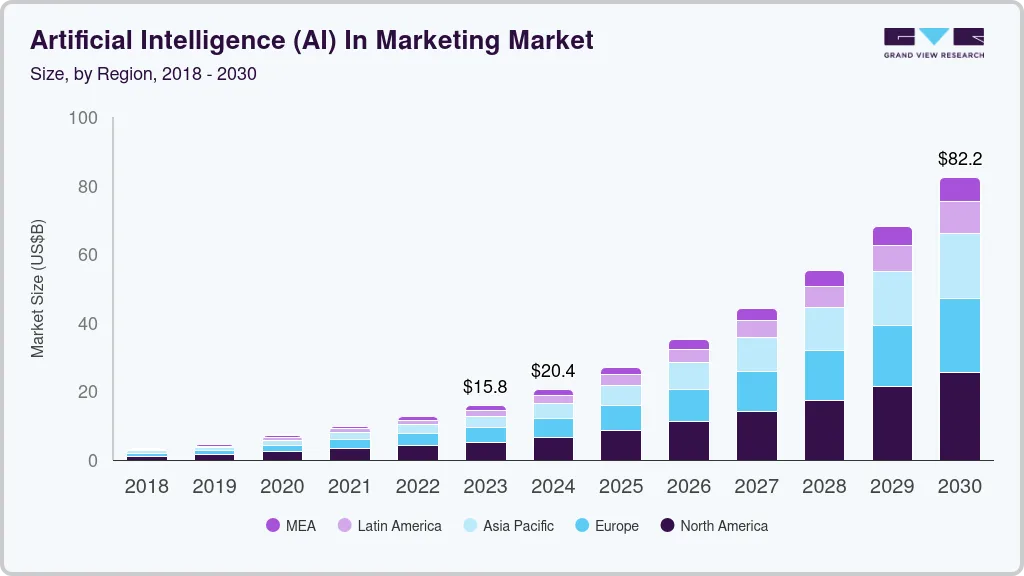
The chart highlights accelerated growth, with North America leading adoption, followed by Europe and Asia.
Global Market Growth Projection Through 2033
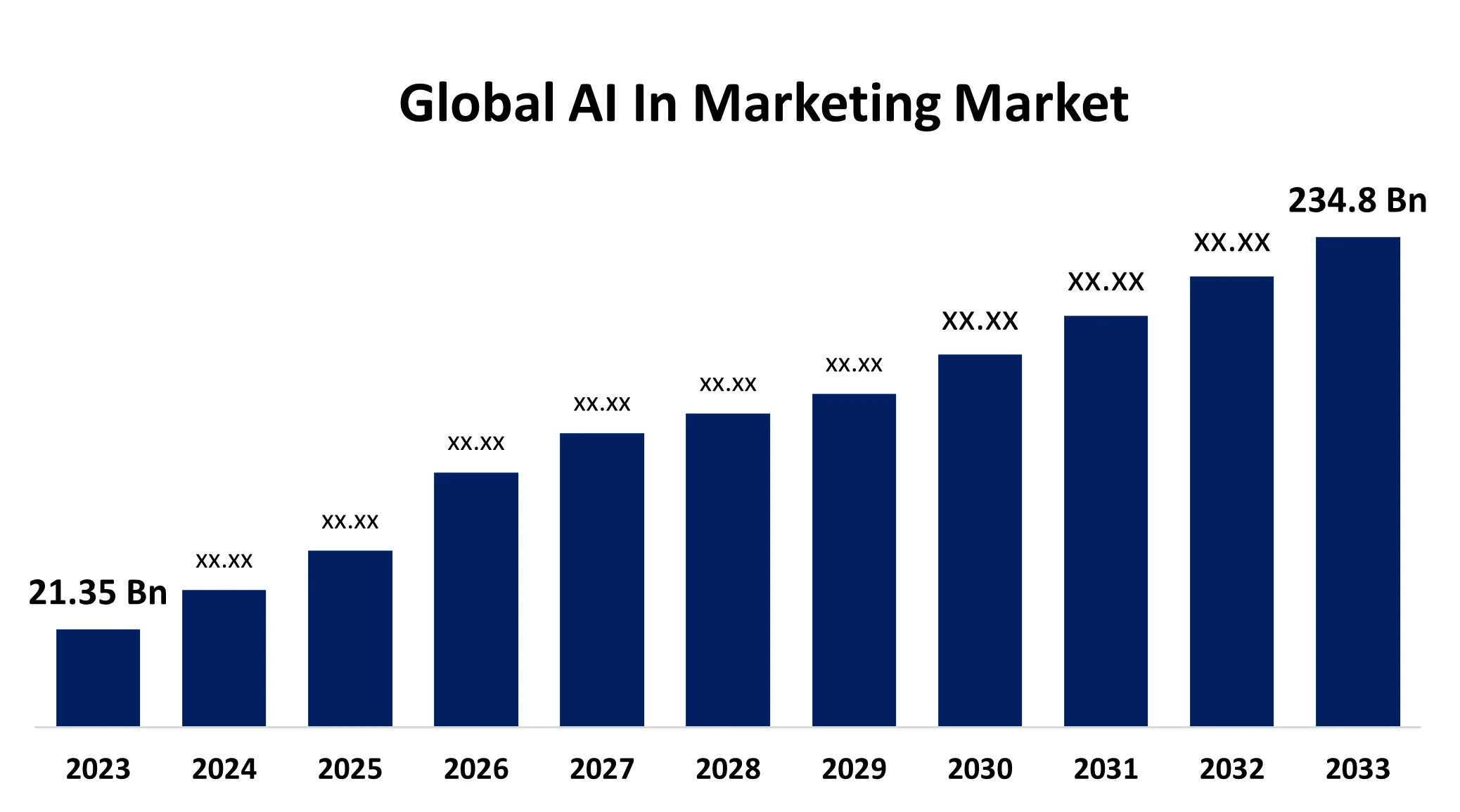
Projection shows growth from USD 21.35 billion in 2023 to USD 234.8 billion by 2033, with a CAGR of 26.7%.
Perceived ROI from AI Investments
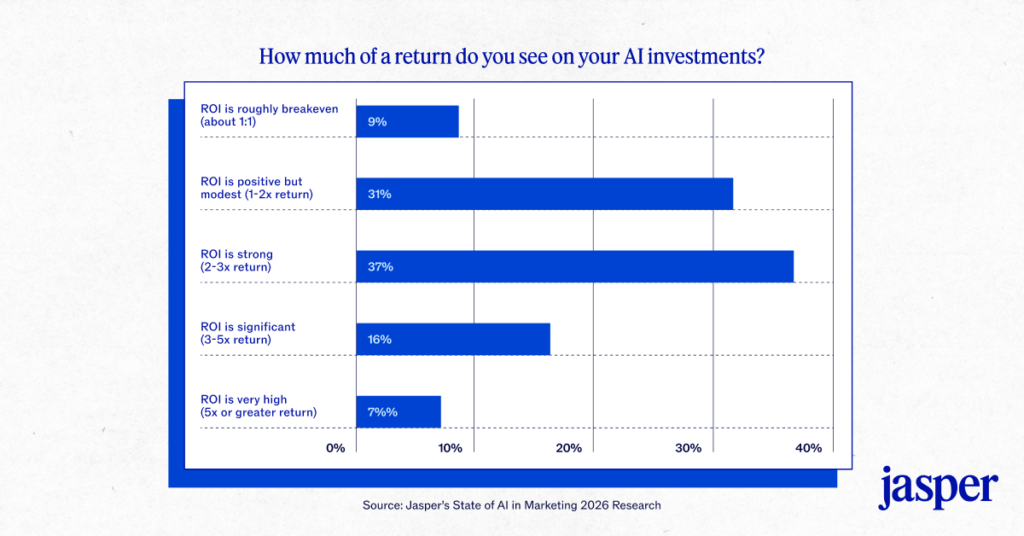
37% of professionals report strong ROI between 2x and 5x, reinforcing the financial viability of AI adoption.
How to Build an Effective Prompt
Expert-Level Example
Creating effective prompts is essential to extract maximum value from AI systems. A strong prompt should be:
- clear
- specific
- contextual
- goal-oriented
- iterative
Advanced marketing prompt example
This type of prompt produces more precise, actionable outputs aligned with real business objectives.
Conclusion
Artificial Intelligence in marketing is no longer optional. It is now a decisive factor for survival and growth.
Companies that adopt AI experience:
- Higher ROI
- Greater engagement
- Scalable operational efficiency
With the market set to double in the coming years, those who invest now build a sustainable competitive advantage.
Start small, refine prompts, test hypotheses, and scale with data.
The future of marketing is intelligent, personalized, and data-driven.
References
- https://digitalmarketinginstitute.com/blog/10-eye-opening-ai-marketing-stats-in-2025
- https://sopro.io/resources/blog/ai-sales-and-marketing-statistics
- https://www.imd.org/blog/marketing/ai-in-marketing
- https://www.rebootonline.com/ai-in-marketing-statistics
- https://www.linkedin.com/pulse/ai-marketing-2026-top-26-trends-redefining-game-noor-salam-khan-btwyc
- https://www.jasper.ai/state-of-ai-marketing-2026
- https://www.statista.com/topics/5017/ai-use-in-marketing
- https://improvado.io/blog/ai-marketing-campaigns
- https://www.forbes.com/advisor/business/ai-statistics
- https://www.creatio.com/glossary/ai-in-marketing