

By Elvis Silva
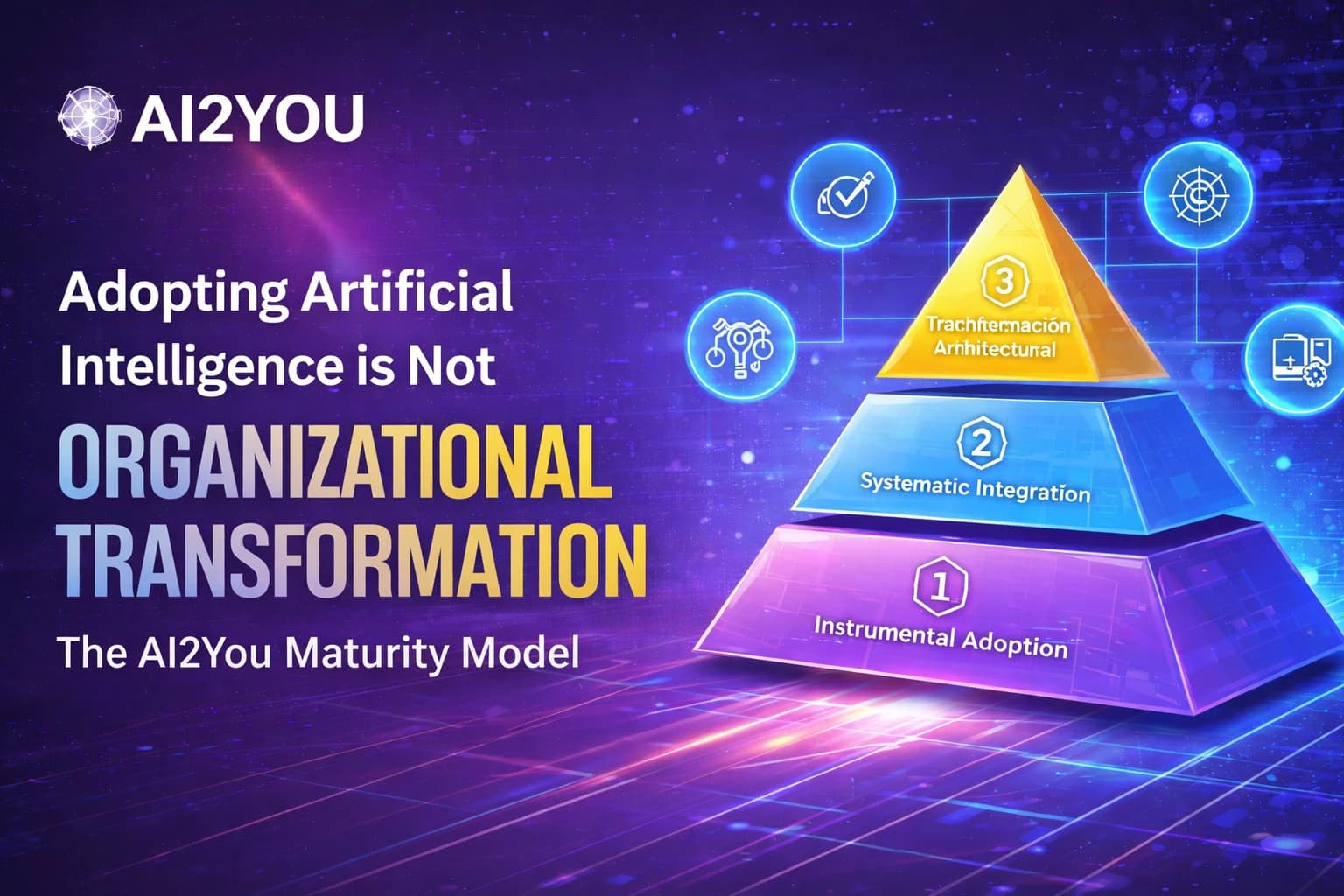
AI Adoption is Not Organizational Transformation: The AI2You Maturity Model
Discover why implementing Artificial Intelligence doesn't guarantee organizational transformation. Learn about AI2You's conceptual model to evolve from instrumental adoption to AI-driven architectural transformation.
Abstract
The accelerated diffusion of Artificial Intelligence (AI) in organizations has produced a recurring phenomenon: the mistaken equation of technological adoption with organizational transformation. While companies incorporate AI-based tools into their operational routines, evidence indicates that such initiatives frequently result only in incremental efficiency gains, without promoting structural changes in business model, governance, or decision-making architecture. This article proposes a conceptual distinction between adoption and transformation, grounded in dynamic capabilities theory and digital transformation literature. An AI Transformation Maturity Model consisting of five evolutionary levels is presented, designed to assess the degree of structural AI integration in organizations. It is concluded that true transformation occurs only when AI transitions from instrumental tool to organizational cognitive infrastructure.
Keywords: Artificial Intelligence; Digital Transformation; Dynamic Capabilities; AI Governance; Organizational Maturity.
1. Introduction
Artificial Intelligence has consolidated itself as a strategic technology in the context of the digital economy. Global organizations such as OpenAI, Google, and Microsoft have driven the democratization of advanced models, making AI applications accessible to companies of different sizes.
However, a misalignment between technological implementation and effective organizational transformation is observed. The simple incorporation of AI tools does not guarantee structural alteration in processes, culture, or corporate strategy. This article starts from the following research question:
We argue that it is not. Transformation depends on systemic integration, organizational reconfiguration, and development of dynamic capabilities.
2. Theoretical Framework
2.1 Digital Transformation
The literature on digital transformation highlights that isolated technological changes do not produce structural transformation. According to Michael Porter strategic approach, competitive advantage derives from value chain reconfiguration, not merely from the adoption of technological tools.
Digital transformation involves organizational redesign, redefinition of value proposition, and resource reorganization.
2.2 Dynamic Capabilities
The concept of dynamic capabilities, developed by David Teece, holds that companies need to integrate, build, and reconfigure internal and external competencies to respond to environments of high technological volatility.
Applying this perspective to AI, transformation occurs when the organization develops the capacity to:
- Integrate AI into core processes
- Learn from algorithmic systems
- Reconfigure decision-making structures
Without these capabilities, AI remains peripheral.
3. AI Adoption: Instrumental Dimension
Adoption is characterized by:
- Isolated departmental implementation
- Use focused on task automation
- Absence of structured governance
- Metrics focused on local productivity
In this configuration, AI acts as an auxiliary tool. There is incremental efficiency, but no systemic reconfiguration.
The organization improves what already exists, without altering its fundamental architecture.
4. AI-Driven Organizational Transformation
Transformation requires simultaneous changes across four dimensions:
4.1 Strategic Dimension
AI integrated into corporate planning and competitive advantage formulation.
4.2 Process Dimension
Complete workflow redesign and integration with core systems.
4.3 Cultural Dimension
Change in decision-making logic, incorporating algorithmic analysis as part of the deliberative process.
4.4 Governance Dimension
Formal structure of policies, accountability, ethics, and risk management associated with AI.
Only when these dimensions are articulated does effective organizational transformation occur.
5. AI Transformation Maturity Model
A five-level model is proposed:
Level 1 – Experimental
Sporadic and decentralized use, without institutional guidelines.
Level 2 – Operational
Automation of repetitive tasks and local efficiency gains.
Level 3 – Integrated
Integration with corporate systems and definition of structured metrics.
Level 4 – Strategic
AI influences corporate decisions and organizational planning.
Level 5 – Architectural
AI becomes the organization's cognitive infrastructure, sustaining business model, governance, and decision-making.
Full transformation occurs only at levels 4 and 5.
6. Discussion
The conceptual results indicate that most organizations are between levels 1 and 3. This explains why many AI investments do not produce structural impact.
The central distinction can be summarized as follows:
| Adoption | Transformation |
|---|---|
| Tool-based | Structural |
| Local | Systemic |
| Efficiency | Reconfiguration |
| Tactical | Strategic |
Transformation is not about having AI, but about reorganizing the company around it.
7. Conclusion
This study demonstrated that the adoption of Artificial Intelligence is not a sufficient condition for organizational transformation. Transformation depends on the development of dynamic capabilities, strategic integration, and structural reconfiguration.
Organizations that treat AI as cognitive infrastructure and not merely as an operational tool show greater potential for generating sustainable competitive advantage.
Future research can empirically test the proposed maturity model, evaluating its application across different economic sectors.
References
Porter, M. E. (1985). Competitive Advantage: creating and sustaining superior performance. New York: Free Press.
Teece, D. J. (2007). Explicating dynamic capabilities: The nature and microfoundations of sustainable enterprise performance. Strategic Management Journal, 28(13), 1319–1350.