
By Elvis Silva
AI First Operating Model: When AI Stops Being a Tool and Becomes the Structure
Understand what AI First is and how an AI-driven operating model transforms digital transformation, B2B marketing, and scalability beyond the isolated use of tools.
Most companies are not transforming with AI.
They're merely decorating their existing operating model with it.
They have ChatGPT accounts, Zapier flows, AI-generated LinkedIn posts, but CAC keeps rising, pipeline forecasts remain guesswork, and marketing and revenue teams still waste hours reconciling spreadsheets.
The uncomfortable truth:
- AI Adoption ≠ Transformation
- AI as a tool increases productivity
- AI as a framework restructures the organization
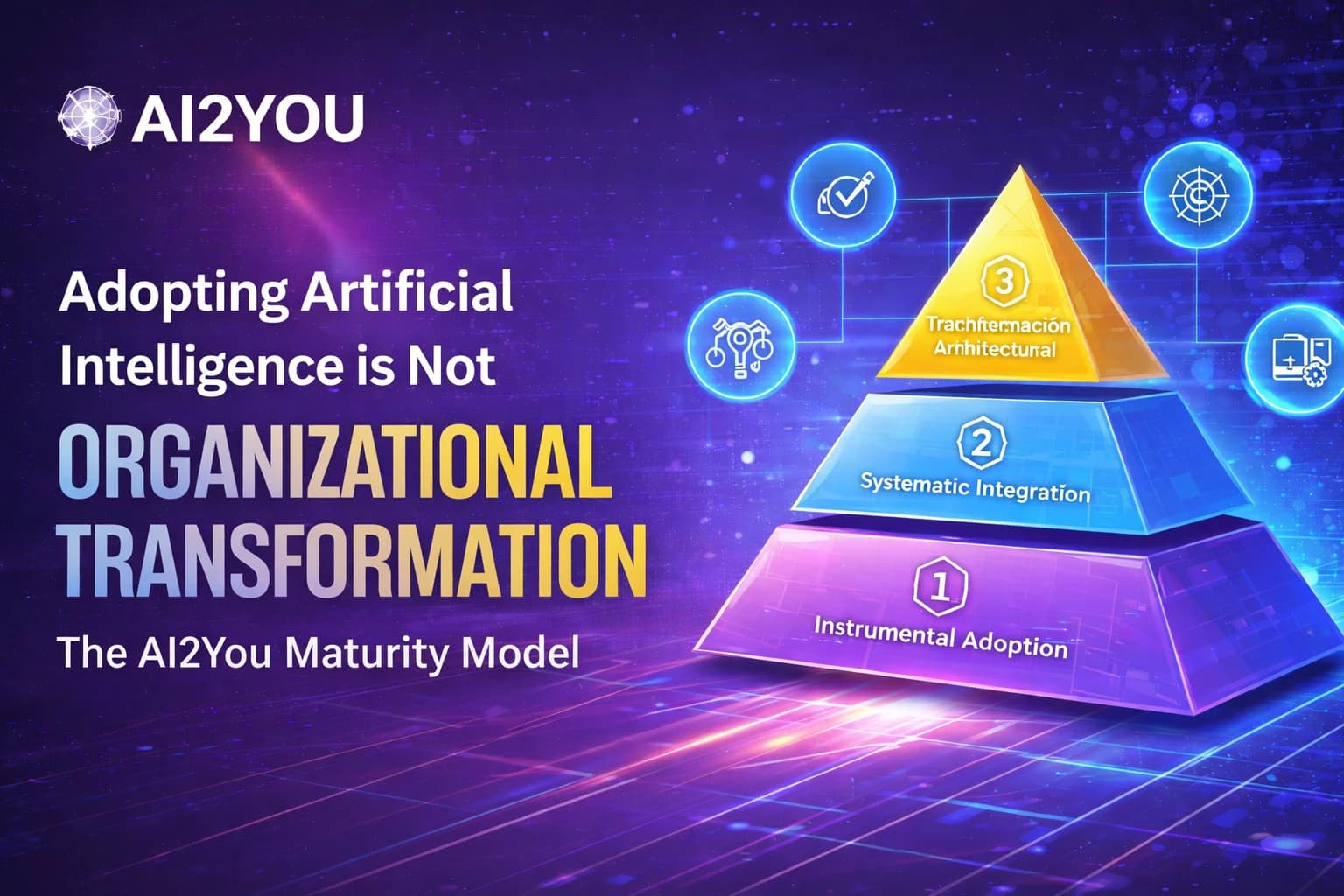
The Four Maturity Levels
- AI Tooling: Individual and isolated use to accelerate specific tasks (writing emails, summarizing meetings, generating images). The organization remains unchanged.
- AI Assisted: Departments adopt AI to accelerate existing processes. Humans remain the central decision node. The operating model is legacy with sprinkles of AI.
- AI Enabled: AI is intentionally inserted into specific workflows (lead scoring, content personalization, basic forecasting). Some processes are redesigned, but the overall architecture remains human and fragmented.
- AI First: AI becomes the structural layer. Workflows are designed with automation as the initial premise. Humans intervene only in exceptions or strategic judgment. Context flows continuously. The operating model is re-architected.
The difference isn't tactical. It's architectural.
The Structural Problem Most Companies Live With Today
Walk into almost any growing B2B company and you'll see the same pattern:
- Marketing runs 17 different isolated prompts
- Sales uses Gong + ChatGPT summaries that never arrive structured in the CRM
- Operations maintains five dashboards that tell different versions of the same story
- Revenue leaders still manually adjust forecasts because no system holds reliable contextual history
Predictable results:
- Inflated CAC (acquisition isn't enriched or nurtured with cross-system intelligence)
- Low forecast reliability (fragmented and stale pipeline data)
- Chaotic scaling (adding headcount becomes the default answer to complexity)
- Data that exists but is never activated ("we have the data, but don't know what to do with it")
These aren't technology problems. They're structural problems that AI tools alone won't solve.
What "AI First" Really Means
AI First is not a software purchase.
It's an operating model, a governance layer, a workflow architecture, and a context engineering system.
In an AI First company:
- Every relevant process is designed with AI as the default executor
- Context (not just data) flows automatically between systems
- Feedback loops are closed and continuous — the system learns from results and self-optimizes
- Governance is proactive: rules, guardrails, and escalation paths are defined before deployment
- Humans are elevated to exception handling, strategic synthesis, and relationship building
The organization stops being a collection of departments that use AI.
It becomes a single intelligent organism, where AI is the connective tissue.
AI First Framework Applied to B2B Marketing
A layered architecture that treats the customer journey as a single, context-aware system, rather than a sequence of handoffs.
Layer 1 — Structured Acquisition
AI designs and executes acquisition motions with native contextual awareness. Intent signals from multiple sources are scored, deduplicated, and routed in real-time. Campaign briefs, landing pages, and initial outreach sequences are generated from a unified knowledge base that already understands recent triggers, technographics, and historical engagement of the target account.
Layer 2 — Intelligent Enrichment
As soon as the signal is captured, AI autonomously enriches the record from internal and external sources. Firmographics, technographics, funding, hiring, and content consumption are synthesized into a living profile. The system flags anomalies (e.g., sudden increase in hiring in a department) and attaches them as structured context, not raw notes.
Layer 3 — Contextual Nurturing
Nurture sequences stop being static drip campaigns. They become dynamic conversations guided by context. The system knows what content the prospect consumed, which pain points were mentioned in earnings calls, which competitors they're evaluating. The message adapts in real-time. Human marketers review only high-value exceptions or creative pivots.
Layer 4 — CRM Integration + Automation
All context from previous layers flows natively into the CRM (or chosen system of record). Opportunities are created, enriched, and routed automatically. Sales sequences are suggested based on enriched context. Handoffs between marketing and sales come with complete provenance, not just a lead score.
Layer 5 — Predictive Optimization Loop
The entire system runs a continuous optimization layer. Performance data from all stages feeds back to Layer 1. The model learns which acquisition channels, messaging frameworks, and enrichment signals actually move pipeline velocity and win rate. It proposes (and in mature stages, implements) structural changes: new content pillars, channel reallocation, process redesign.
The power isn't in any isolated layer.
It's in the continuous bidirectional flow of context and the closed optimization loop.
How Metrics Actually Change
AI Assisted companies improve efficiency metrics (time saved, output volume).
AI First companies change the fundamental economics:
- CAC drops because acquisition becomes hyper-targeted and waste is continuously eliminated
- LTV rises because nurturing is genuinely personalized and timely → higher conversion, expansion, and retention
- Pipeline Velocity increases because context-rich records move through sales stages faster
- Forecast Reliability improves dramatically (single source of truth + probabilistic modeling + complete provenance)
- Operational Efficiency becomes structural, not incremental → revenue growth decouples from headcount growth
The organization stops competing on who works harder with AI and starts competing on who built the best structure.
The Role of Structural Partners
Organizations that reach AI First don't get there by buying more tools or running more pilots. They redesign the operational backbone with deliberate architecture.
This is where specialized workflow architects come in. Companies like AI2You operate at the intersection of context engineering, governance design, and B2B growth systems. They don't sell prompts or automation scripts. They design context-aware layered operating models that transform AI from a productivity layer into a structural advantage.
They help leadership answer the hard questions:
- Where should context live and how should it flow?
- Which decisions should remain human?
- How do we govern autonomous systems without creating new bottlenecks?
- How do we measure structural progress, not just task ROI?
The New Competitive Frontier
AI Assisted companies will continue competing on efficiency.
They'll squeeze more output from the same processes.
AI First companies will compete on structure.
They'll operate at a different level of predictability, adaptability, and capital efficiency.
The gap between the two is widening faster than most executives realize.
Reflection question for leadership:
Look at your current marketing and revenue stack.
Are you still bolting AI onto legacy processes — or have you begun the harder and more leveraged work of redesigning processes around AI?
The answer will determine whether your organization merely survives the next wave of AI advancement… or shapes it.