

The End of Reactive On-Call: How Agentic AIOps Transforms Infrastructure into a Self-Healing System
Modern SRE teams operate environments with hundreds of microservices, real-time data pipelines, and SLOs that tolerate no degradation. Observability has evolved — OpenTelemetry unified collection, Prometheus and Grafana made metrics accessible, distributed traces made visible what was once a black box. But the intelligence applied to that data has stagnated: humans are still the central processor for every alert, every correlation, every remediation decision. Agentic AIOps breaks that dependency. This article presents the complete 4-layer architecture, with functional Python code for implementing an Ops Agent that autonomously detects, diagnoses, and remediates incidents, a 5-stage maturity roadmap for any engineering team, and real cost analysis per tool — from open-source to enterprise.
The Incident That Should Never Have Happened
It's 2:17 AM. PagerDuty fires. You open your laptop and find 847 active alerts — high memory on cluster A, elevated latency on the payments service, 503 errors on checkout and authentication endpoints, CPU spike on the queue processing worker. Every alert is real. None of them tells you which one is causing the others.
You spend the next 38 minutes doing what every SRE team does: toggling between Grafana, Loki, Jaeger, and a terminal. Manually correlating the timestamp of the first alerts against the deploy history. At 2:55 AM you discover that a silent configuration rollout — approved the previous afternoon, automatically executed by the pipeline at 2:03 AM — introduced a memory leak in the session service. The leak cascaded into the database connection pool, which cascaded into authentication timeouts, which cascaded into checkout errors. MTTR: 53 minutes. Estimated downtime cost: between $280,000 and $300,000 at $5,600/minute (Gartner, estimate for mid-size enterprise e-commerce).
The problem isn't that your team responded poorly. Fifty-three minutes is, by most SRE benchmarks, considered a good response. The problem is the premise that still defines how most organizations run their infrastructure: a human must be awake, alert, and available to connect the dots that a system should connect by itself. When infrastructure is complex enough that an engineer takes 38 minutes to identify an incident's root cause, it is already too complex to rely exclusively on engineers to do that.
What AIOps Is (and What It Is Not)
AIOps — Artificial Intelligence for IT Operations — is the application of machine learning, large-scale operational data analysis, and, in the current generation, LLMs and autonomous agents over the observability data of an IT system, for four specific and measurable purposes:
- Early anomaly detection before issues become user-impacting incidents
- Automatic event correlation across multiple sources to identify root cause without human intervention
- Alert noise reduction through intelligent deduplication and prioritization
- Autonomous suggestion or execution of remediation actions, closing the loop without waiting for the on-call engineer
What AIOps is not: it is not having more dashboards. It is not creating more granular alerts. It is not a product you buy and turn on. And, critically, it is not the same thing as observability — observability is the ability to understand the internal state of a system from its external outputs; AIOps is what you do with that capability, intelligently and autonomously.
The Shift That LLMs and Agents Make Possible
The first generation of AIOps (roughly 2018–2023) used classical ML over telemetry data: alert clustering, temporal window correlation, time-series anomaly detection, severity classification models. It was useful. It reduced noise. But humans remained in the loop for every decision that required contextual reasoning — and most relevant decisions do.
The second generation — which this article calls Agentic AIOps — changes the contract fundamentally. LLMs can read logs in natural language, consult runbooks as text, reason about the causal sequence of events, and communicate diagnoses in a way any engineer can understand. Autonomous agents can execute corrective actions via APIs, verify the outcome, and iterate. The combination delivers what the first generation promised but could not: closing the loop from alert to remediation without human intervention for the most frequent class of incidents.
| Capability | AIOps Generation 1 | Agentic AIOps (Generation 2) |
|---|---|---|
| Anomaly detection | ✅ Classical ML (LSTM, Isolation Forest) | ✅ Classical ML + LLM contextualization |
| Event correlation | ✅ Temporal window and topology | ✅ Semantic causality via LLM |
| Root cause diagnosis | ⚠️ Probabilistic suggestion | ✅ Natural language reasoning with evidence |
| Runbook lookup | ❌ Not native | ✅ RAG over operational documentation |
| Autonomous remediation | ❌ Suggestion only | ✅ Execution with outcome verification |
| Contextual communication | ❌ Structured alerts | ✅ Incident narrative for Slack/Teams |
| Learning from outcomes | ⚠️ Batch retraining | ✅ Continuous feedback loop |
| Human in the loop | All decisions | High-risk decisions only |
The 2024–2026 inflection point is not technological — LLM models existed before. It is operational maturity: engineering teams now have standardized observability data (OpenTelemetry), mature streaming infrastructure (Kafka), and stable agent frameworks (LangChain 0.3.x, LangGraph) to reliably connect the pieces in production.
Architecture: The 4 Layers of Modern AIOps
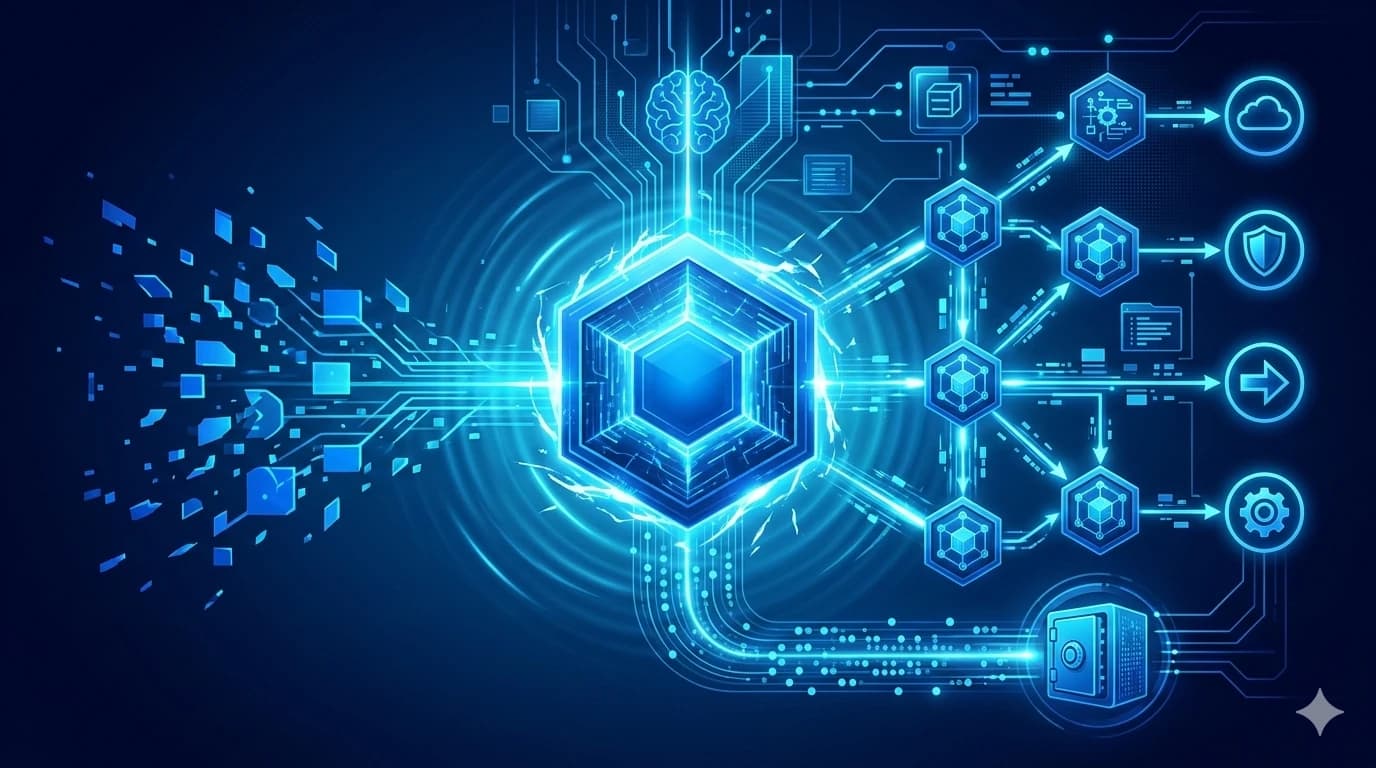
A mature AIOps architecture is not a single product — it is a composition of layers with well-defined responsibilities. Each layer can be built with open-source, commercial, or hybrid tools depending on your maturity stage and available budget.
Layer 1: Unified Observability
The historical problem with observability was fragmentation: metrics in Prometheus, logs in Elasticsearch with proprietary formats, traces in Zipkin with manual instrumentation. OpenTelemetry (OTel) solved this with a unified SDK and protocol that works with any language and any backend.
For AIOps, the quality of input data directly determines the quality of diagnosis. An Ops Agent receiving logs without consistent structure, metrics without standardized labels, or traces without context propagation will produce poor diagnoses — regardless of the LLM quality.
Recommended stack for this layer:
| Component | Tool | Function | Estimated cost |
|---|---|---|---|
| Unified collection | OpenTelemetry Collector | Receives metrics, logs, traces from any source | Free (CNCF) |
| Metrics | Prometheus + Grafana | Storage and visualization | Free (OSS) |
| Logs | Loki (Grafana Labs) | Label-indexed logs, low cost | Free (OSS) / $50–200/mo cloud |
| Traces | Tempo (Grafana Labs) | Distributed traces integrated with Grafana | Free (OSS) |
| Alerting | Alertmanager | Alert routing with basic deduplication | Free (OSS) |
Layer 2: Real-Time Ingestion and Streaming
Layer 1 produces data. Layer 2 moves that data reliably, at high speed and volume, to where intelligence can process it. Apache Kafka is the market standard — not because it is simple to operate, but because it provides ordering guarantees, event replay, and durability that production AIOps systems require.
ClickHouse deserves special mention: a columnar database optimized for analytical time-series workloads, capable of processing billions of log events with sub-second queries. For the telemetry volume of a mid-size microservices environment, the difference between ClickHouse and PostgreSQL is the difference between a 200ms query and a 45-second one.
| Component | Tool | Function | Estimated cost |
|---|---|---|---|
| Event streaming | Apache Kafka | Real-time alert pipeline | Free (OSS) / Confluent $400+/mo |
| Time-series storage | ClickHouse | Analytical storage for metrics and logs | Free (OSS) / Cloud $200–800/mo |
| Log pipeline | Vector (Datadog) | Log transformation and routing | Free (OSS) |
| Embeddings pipeline | Fluent Bit | Lightweight log collection in containers | Free (OSS) |
Layer 3: Intelligence — Classical ML + LLM + Vector DB
This is the layer that differentiates AIOps from traditional observability. It has three subsystems with distinct responsibilities:
Subsystem 1 — Anomaly detection (classical ML): Isolation Forest for real-time multivariate anomalies, LSTM or Prophet for time-series detection with seasonality. Faster, cheaper, and more explainable than LLMs for this specific use case.
Subsystem 2 — Semantic contextualization (LLM): When an anomaly is detected, the LLM receives full context — anomalous metrics, related logs, affected traces, history of similar incidents — and produces a root cause diagnosis in natural language with cited evidence.
Subsystem 3 — Operational memory (Vector DB): Runbooks, post-mortems, resolved incident history, and architecture documentation indexed as embeddings. The agent queries this repository via RAG to contextualize each new incident with accumulated institutional knowledge.
| Component | OSS | Commercial | Estimated cost |
|---|---|---|---|
| Anomaly detection | scikit-learn, statsmodels | Dynatrace Davis AI | Free / $300–2,000+/mo |
| LLM for diagnosis | Llama 3.1 70B (self-hosted) | GPT-4o, Claude Sonnet | $0 self-hosted / $50–500/mo API |
| Agent framework | LangChain 0.3.x, LangGraph | — | Free (MIT) |
| Vector DB | FAISS, Chroma | Pinecone, Weaviate Cloud | Free / $70–400/mo |
Layer 4: Action, Remediation, and Feedback Loop
Layer 4 closes the loop. When the agent produces a diagnosis with sufficient confidence and identifies a remediation action with calculated low risk, it executes it — restarts a pod, rolls back a deploy, scales up replicas, purges a cache. For higher-risk actions, it notifies the responsible engineer with full context and waits for approval.
The feedback loop is where AIOps matures over time: every resolved incident, with its diagnosis, action taken, and outcome recorded, feeds back into the Vector DB as training data and into the history the agent consults on subsequent incidents. A system that has been running for six months produces significantly better diagnoses than on day one — not because the model changed, but because the accumulated operational context is richer.
Implementing the Ops Agent: From Alert to Remediation
The agent below implements the full flow: consumes alerts from a Kafka topic, applies anomaly detection, queries runbooks via RAG, reasons about root cause with an LLM, and executes remediation via kubectl. The code is modular — each component can be tested and deployed independently.
6.1 Kafka Consumer — Alert Ingestion
Expected output: Consumer started and logging "Ops Agent consumer started. Waiting for alerts...". Alerts with warning and info severity are discarded before reaching the LLM, reducing API cost and latency.
6.2 Anomaly Detection with Isolation Forest
Expected output: Alerts with score < -0.5 proceed to the LLM. Higher-score alerts are discarded. In an environment of 2,400 alerts/day, this filter should reduce to 200–400 the alerts that reach the agent (estimate), cutting API cost by 80–90%.
6.3 RAG over Runbooks with LangChain + FAISS
Expected output: Given an incident like "memory leak in session service causing connection pool timeout", the retriever returns the 4 most semantically similar runbook chunks in under 200ms (FAISS is in-memory, no network latency).
6.4 The ReAct Agent — Reasoning About the Incident
6.5 Autonomous Remediation via kubectl
Expected output: Given the input "production/session-service", the tool executes the rolling restart via the Kubernetes API and returns confirmation. The deployment restarts pods gradually, respecting the maxUnavailable and maxSurge settings configured — no additional downtime.
6.6 Contextual Slack Notification
Expected output: A structured message in #ops-incidents with the header "Ops Agent — Incident Resolved", a natural-language diagnosis narrative, the action executed, and the verified result. The team wakes up to a resolved and documented incident — not to an alert demanding attention.
Maturity Roadmap: 5 Stages from Monitoring to Self-Healing
AIOps is not an implementation — it is a journey with progressive stages and clear dependencies between them. Attempting to jump from Stage 0 directly to Stage 4 without building the foundations of the intermediate stages is the most common reason AIOps projects fail.
| Stage | Name | Avg MTTR (estimate) | Alert noise | Human in loop |
|---|---|---|---|---|
| 0 | Reactive Monitoring | 2–6 hours | 100% | All decisions |
| 1 | Unified Observability | 45–90 min | 80% | All decisions |
| 2 | Classical AIOps | 20–45 min | 30–40% | Diagnosis and remediation |
| 3 | Contextual AIOps with LLM | 10–20 min | 15–20% | High-risk remediation |
| 4 | Agentic AIOps | 2–8 min | 5–10% | High-risk decisions |
| 5 | Self-Healing Infrastructure | <2 min | <5% | Exceptions and learning |
Stage 0: Reactive Monitoring
Where most organizations are today. Threshold-based alerts (if cpu > 80% then alert), multiple monitoring systems without integration, on-call engineer as the central correlation processor.
Entry criterion: Any environment with more than 5 services in production. Exit criterion to Stage 1: Decision to adopt OpenTelemetry as the instrumentation standard.
What to do now: Audit the current state of observability. Quantify: how many alerts per week, what is the false-positive rate, what is the average MTTR over the last 90 days. These numbers are the baseline that will demonstrate ROI in subsequent stages.
Stage 1: Unified Observability
Prerequisite: Team with the capacity to instrument services with OpenTelemetry and operate Prometheus + Grafana.
What to build: OTel instrumentation on all critical services. Correlation of logs, metrics, and traces in a single pane. Alertmanager configured with basic deduplication by service group. Runbooks documented in markdown for the 20 most frequent incidents.
Estimated cost: $0–200/mo (OSS) + engineering time (2–4 weeks for initial instrumentation). Success metric: 30%+ reduction in MTTD (Mean Time to Detect) within 90 days.
Stage 2: Classical AIOps
Prerequisite: Unified observability running with at least 30 days of historical data.
What to build: Anomaly detection with Isolation Forest or LSTM over metric time-series. Intelligent alert deduplication by temporal window and affected service. Automatic event correlation by service dependency topology.
Estimated cost: $0 (scikit-learn, OSS) + $200–600/mo with Datadog or New Relic with AIOps module. Success metric: 60%+ reduction in alert noise. MTTR falling to 20–45 minutes for routine incidents.
Stage 3: Contextual AIOps with LLM
Prerequisite: Streaming pipeline (Kafka) running. Runbooks indexed as embeddings (FAISS or Chroma). Previous incident history documented.
What to build: LLM integration for root cause diagnosis with RAG over runbooks. The agent does not yet execute actions — it only diagnoses and suggests. The engineer approves or rejects each suggestion. This approval cycle is fundamental: it generates the feedback data that will calibrate the agent for Stage 4.
Estimated cost: $50–300/mo in LLM API calls (GPT-4o or Claude Sonnet) depending on incident volume. Success metric: 70%+ accuracy in root cause diagnosis validated by engineers. MTTR below 15 minutes for incidents the agent correctly diagnoses.
Stage 4: Agentic AIOps
Prerequisite: Stage 3 running with diagnosis accuracy >= 70% validated for at least 60 days. Kubernetes RBAC configured with minimum permissions for the agent's service account. Escalation playbook defined (when the agent does not act and instead notifies).
What to build: The complete Ops Agent with an autonomous remediation loop. Action classification by risk (low: pod restart / scale up; medium: deploy rollback; high: network or database changes). Low-risk actions executed autonomously. Medium-risk actions with 5-minute Slack approval before executing. High-risk actions always with a human.
Estimated cost: $100–500/mo in API + cost of running the Kafka/ClickHouse pipeline. Success metric: 60–80% of routine incidents resolved autonomously (estimate). MTTR below 8 minutes for incidents handled by the agent.
Stage 5: Self-Healing Infrastructure
Prerequisite: Stage 4 running for at least 6 months with a feedback loop feeding the Vector DB with resolved incidents and their outcomes.
What it is: Infrastructure detects emerging degradations before they become incidents, proactively adjusts resources, and documents every decision for audit. MTTR is no longer the primary metric — the metric becomes incidents prevented.
The engineer's role changes: No longer resolving incidents — but governing the quality of the system that resolves them. Reviewing incorrect diagnoses. Adding runbooks for new failure patterns. Defining risk boundaries for new categories of autonomous action. This is the operational contract of the AI-First model applied to infrastructure.
AIOps as AI-First Foundation
Previous articles in this series established the central AI2You principle: AI is not an additional layer on top of existing processes — it is the architectural foundation upon which processes, decisions, and infrastructure must be redesigned. AIOps is where that principle finds its most concrete and measurable expression.
When we build memory architectures for multi-agent systems, we are creating the ability for a system to retain and retrieve accumulated knowledge. The Ops Agent's Vector DB — indexing runbooks, post-mortems, and incident history — is exactly that architecture applied to the operational domain. The agent is not merely reactive; it learns from every incident it resolves.
When we document multi-agent orchestration with LangChain and LangGraph, we are defining how multiple specialized agents collaborate. A mature AIOps environment does not have a single monolithic Ops Agent — it has a hierarchy: a triage agent that classifies alerts, specialized agents by domain (network, database, application, Kubernetes), and an orchestrator that coordinates cross-domain diagnoses.
The strategic implication that few AIOps articles articulate: when 60–80% of operational incidents are handled autonomously, what happens to the SRE team? The answer is not headcount reduction — it is cognitive capacity reallocation. Engineers who today spend 40% of their time on reactive on-call can redirect that time to work that creates compounding value: improving observability coverage, reducing technical debt, architecting more resilient systems. The infrastructure self-heals; the engineers make it harder to break. That is the operational version of AI-First.
FAQ - AIOps Agentic: Self-Healing Infrastructure
1. What is AIOps and how is it different from traditional observability?
AIOps (Artificial Intelligence for IT Operations) is the application of machine learning, LLMs, and autonomous agents to IT operational data with four measurable goals: detecting anomalies before they become incidents, automatically correlating events to identify root cause, reducing alert noise, and executing autonomous remediation. Observability is the ability to understand a system's internal state from its external outputs (metrics, logs, traces). AIOps is what you do intelligently and autonomously with that ability. Having beautiful Grafana dashboards is observability. An agent that reads that data, diagnoses root cause, and restarts the pod on its own is AIOps.
2. What is Agentic AIOps and how does it differ from first-generation AIOps?
First-generation AIOps (2018–2023) relied on classical ML — alert clustering, time-series anomaly detection, temporal-window correlation. It was useful for noise reduction, but humans remained in the loop for every decision requiring contextual reasoning. The second generation, called Agentic AIOps, incorporates LLMs and autonomous agents: the agent can read logs in natural language, query runbooks as text via RAG, reason about the causal sequence of events, and execute corrective actions through APIs — verifying results and iterating. The key difference: in Generation 1, humans still close the loop. In Generation 2, humans are only engaged for high-risk decisions.
3. What are the 4 layers of modern AIOps architecture?
The architecture consists of:
- Layer 1 — Unified Observability: OpenTelemetry, Prometheus, Grafana, Loki, Jaeger/Tempo, and Alertmanager. Standardized collection of metrics, logs, traces, and events.
- Layer 2 — Ingestion & Streaming: Apache Kafka, ClickHouse, Vector, and Fluent Bit. Moves telemetry data at high speed and volume to where intelligence can process it.
- Layer 3 — Intelligence: Classical ML (Isolation Forest, LSTM) for anomaly detection; LLM (GPT-4o, Claude, Llama) for natural-language contextual diagnosis; and Vector DB (FAISS, Weaviate, Pinecone) as operational memory storing runbooks and incident history via RAG.
- Layer 4 — Action & Feedback: Autonomous remediation via kubectl/Ansible, notifications via Slack/PagerDuty, Jira ticket creation, and a feedback loop that feeds each resolved incident back into the Vector DB to improve future diagnoses.
4. How does the Ops Agent decide whether to act autonomously or escalate to a human?
The agent classifies actions by risk level:
- Low risk (e.g., pod restart, replica scale-up): executed autonomously without approval.
- Medium risk (e.g., deployment rollback): the agent notifies the on-call engineer via Slack with full context and waits up to 5 minutes for approval before executing.
- High risk (e.g., network or database changes): always requires human intervention, regardless of the agent's diagnostic confidence.
This model ensures the agent autonomously resolves the most frequent, lowest-risk incidents while preserving human control where the cost of error is highest.
5. What role does Isolation Forest play in the AIOps pipeline?
Isolation Forest acts as an anomaly pre-filter before any alert reaches the LLM. It evaluates numerical features from the alert payload (metric value, alert duration, affected service, impacted pod count) and discards alerts that don't represent a true anomaly — i.e., noise. In an environment generating 2,400 alerts per day, this filter reduces to 200–400 the alerts that actually reach the agent, representing an 80–90% reduction in LLM API call costs and processing latency.
6. What is RAG and how is it used in the AIOps context?
RAG (Retrieval-Augmented Generation) is the technique of retrieving relevant documents from a vector store before sending context to the LLM for response generation. In the Ops Agent, runbooks, post-mortems, and incident history are indexed as embeddings in a Vector DB (FAISS or Pinecone). When a new incident occurs, the agent semantically searches for the most relevant documents and includes them in the LLM prompt — giving the model access to the team's accumulated institutional knowledge without requiring fine-tuning or retraining of the base model.
7. What are the 5 AIOps maturity stages and how do you progress through them?
| Stage | Name | Summary |
|---|---|---|
| 0 | Chaos | No unified observability |
| 1 | Unified Observability | OTel + Prometheus + structured runbooks |
| 2 | Classical AIOps | Anomaly detection + alert deduplication |
| 3 | Contextual AIOps with LLM | LLM diagnosis + RAG; humans still approve actions |
| 4 | Agentic AIOps | Autonomous remediation loop for low-risk incidents |
| 5 | Self-Healing Infrastructure | Proactive prevention; MTTR is no longer the primary metric |
Each stage requires the previous one to be running stably. Skipping stages is not recommended: the runbooks written in Stage 1 become the RAG corpus in Stage 3.
8. How much does it cost to implement AIOps? Is an enterprise budget required?
No. The full stack can be built entirely with open-source tools:
- Stages 1–2: Zero cost with OpenTelemetry, Prometheus, Grafana, Loki, and scikit-learn (OSS). Optional: Datadog or New Relic with AIOps module at $200–600/month.
- Stage 3: $50–300/month in LLM API calls (GPT-4o or Claude Sonnet), depending on incident volume.
- Stage 4: $100–500/month in API costs + Kafka/ClickHouse infrastructure (OSS self-hosted or cloud at $200–800/month).
Enterprise solutions like Dynatrace with Davis AI start at $300–2,000+/month for anomaly detection alone. The choice between OSS and commercial depends on the operational capacity available to maintain the infrastructure.
9. What changes for SRE engineers with mature AIOps?
The role isn't eliminated — it's reallocated. When 60–80% of routine incidents are resolved autonomously, engineers who currently spend 40% of their time on reactive on-call can redirect that capacity toward: improving observability coverage, reducing technical debt, architecting more resilient systems, and governing the quality of the AIOps system itself (reviewing incorrect diagnoses, adding runbooks for new failure patterns, defining risk boundaries for new categories of autonomous action). The infrastructure heals itself; engineers make it harder to break.
10. Where should you start? What does the first two-week checklist look like?
Week 1 — Diagnosis and baseline:
- Measure average MTTR and MTTD over the past 90 days
- Audit observability coverage (which services have correlated metrics, logs, and traces)
- Quantify the rate of alerts discarded without action over the past 30 days
- Inventory existing runbooks (are they structured or scattered across wikis?)
- Identify the 5 most frequent incident types over the past 6 months
Week 2 — Architecture decision:
- Define current maturity stage (0–2) using objective criteria
- Choose between OSS stack (Kafka + FAISS + scikit-learn) or commercial platform (Dynatrace, Datadog) based on budget and available operational capacity
- Prioritize OpenTelemetry instrumentation on the 3 most critical services as a pilot project
- Define success KPIs for the first 90 days (MTTR target, alert noise reduction target)
Next Steps and Closing Thoughts
If you have reached this point and are evaluating where to start, the checklist below is the roadmap for the next two weeks:
Week 1 — Diagnosis and baseline:
- Measure average MTTR and MTTD over the last 90 days (if this data does not exist, that itself is the finding)
- Audit observability coverage: which services have correlated metrics, logs, and traces?
- Quantify alert noise: what is the rate of alerts discarded without action over the last 30 days?
- Inventory existing runbooks: are they in structured markdown or scattered across wikis?
- Identify the 5 most frequent incident types over the last 6 months
Week 2 — Architecture decision:
- Define current maturity stage (0–2) with objective criteria
- Choose between open-source build (FAISS + Kafka + LangChain) or commercial platform (Dynatrace, Datadog) based on budget and available operational capacity
- Prioritize OpenTelemetry instrumentation on the 3 most critical services as a pilot project
- Define success KPIs for the first 90 days (MTTR target, alert noise reduction target)
The inflection point for AIOps in 2026 is not the technology — the technology is mature. It is the organizational willingness to redesign the operational contract: to accept that infrastructure that thinks is fundamentally different from infrastructure that you monitor. The difference between the two is not measured only in MTTR — it is measured in how many hours of your best engineers are consumed by work a machine can do better, faster, and without waking at 2 AM.
Further reading from this series:
- Memory Architecture for Multi-Agent Systems — the foundation for the Ops Agent's Vector DB
- Agent Orchestration with LangChain and CrewAI — how to scale from one to multiple specialized agents
- AI-First: Autonomous Sales Agents at Zero Cost — the same agent pattern applied to the commercial domain
Published on the AI2You Blog · Elvis Silva